



Introducing XL SCAN and SCANmotionControl: Uniting Precision, Scale and Versatility for Laser Micromachining
In today’s electronics, flexible-display, and advanced-foil manufacturing industries, there is a growing demand for micromachining solutions that deliver both high precision and large-area processing. Whether drilling microvias in printed circuit boards (PCBs), creating through-holes in foil-based flexible electronics, or cutting large area display films and foils, manufacturers face the challenge of scaling without sacrificing accuracy or throughput.
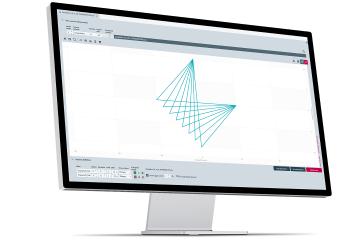
The XL SCAN system from SCANLAB, developed in collaboration with ACS Motion Control, offers a breakthrough. By synchronously controlling a 2D scan head and a mechanical XY stage, XL SCAN enables virtually unlimited working area while maintaining sub-micron precision and high throughput. This makes it ideally suited for demanding tasks such as UV/ultrashort-pulse (USP) laser drilling and large-area display foil cutting.
This article explains the technology in practical terms and highlights how XL SCAN enables demanding production tasks such as UV laser drilling, display film laser cutting, and a broad spectrum of other high precision large-field processes. We also detail the option of integrating high-performance stages from SCANLAB partner Physik Instrumente (PI), giving OEMs a proven path to ultra-precise motion platforms in an XL SCAN architecture.
The challenge of large-field micromachining
As microelectronics, photonics, medical devices, and display manufacturing scale up, the parts being processed are getting larger—while features remain microscopic. Typical examples include large PCB panels, glass substrates for microfluidics, meter-scale functional foils, and display films.
Conventional large-field laser processing usually follows one of two methods:
- Step-and-scan (tiling) using a galvo scanner:
The stage positions the workpiece to a tile, the scan head processes inside its image field, then the stage moves to the next tile. This introduces non-productive time, requires overlap management, and risks visible stitching errors at tile boundaries. - Full-field stage processing:
The laser beam stays near a fixed position while the stage traces the full pattern. This can be accurate, but stage dynamics limit speed and can excite vibration, especially with frequent direction changes.
Both approaches are increasingly inadequate when manufacturers want:
- large processing areas,
- micro-scale accuracy, and
- high throughput—at once. XL SCAN targets exactly this pain point.
XL SCAN at a glance
XL SCAN is a combined scan solution that synchronizes a SCANLAB 2D scan head with a 2-axis XY positioning stage. It is designed for “workpieces without size limitations,” because the working area is bounded only by the traversal range of the mechanical axes, not the scanner’s image field.
Key features include:
- scan solution for large-field processing
- high throughput
- market-leading accuracy
- no stitching errors
- high-dynamic processing without stage vibration
- unlimited job duration
- automatic laser control, such as Spot Distance Control (SDC)
- ability to combine multiple software instances, stages, and scan heads.
These features matter not as a checklist, but because they directly translate to faster, cleaner, more consistent manufacturing on large parts.
Smart Control: SCANmotionControl and the Advantages of Synchronized Motion
A core strength of XL SCAN lies in its control concept, implemented in the software package SCANmotionControl (and optionally its GUI variant SCANmotionStudio). Rather than relying on feedback loops (which can add latency) to compensate for stage motion deviations, SCANmotionControl precomputes optimal trajectories for both the scanner and the stage — taking into account their physical limitations (acceleration, jerk, travel range).
Key benefits:
- Tracking-error-free operation:
Because the trajectory is preplanned, the system does not need to constantly adjust the scanner to correct for stage motion errors—eliminating one major source of inaccuracy typical in other “hybrid”. systems. - High throughput:
Simultaneous motion means that processing doesn’t stop while the stage repositions. In fact, compared to traditional “step-and-scan” systems, XL SCAN can increase throughput by ~ 41%. - Automatic laser control:
The system includes advanced control over laser parameters, such as the innovative Spot Distance Control (SDC), which ensures constant pulse spacing (and thus consistent energy deposition per unit length), independently of acceleration or deceleration phases. This is essential for materials that are sensitive to heat input (e.g., foils, plastics, glass). - Deflection-Angle Dependent Energy Control:
The system can adjust laser parameters (power, pulse rate) depending on the scan head’s deflection angle—compensating for spot size variations and ensuring uniform energy density across the entire scan path. - Flexible job planning and simulation:
SCANmotionControl (and SCANmotionStudio) allows users to import CAD data or draw laser paths, define process parameters, simulate jobs (without hardware), and optimize trajectory planning before hardware execution. This reduces setup time and trial-and-error.
Together, this makes XL SCAN not just a powerful hardware solution, but a fully integrated laser-micromachining platform — giving integrators and OEMs high speed, large-area coverage, and unmatched precision.
Application focus 1: UV laser drilling (PCBs, glass, ceramics)
UV laser drilling is one of the best showcases for XL. SCAN because it combines large-area coverage with micro-scale features and extremely high hole counts.
Large-area PCB drilling
Modern HDI and IC-substrate panels can exceed 500 × 500 mm while demanding tens of millions of microvias. Step-and-scan creates long idle times and stitching mismatch between tiles. XL SCAN eliminates that by allowing the scan head to “surf” over the panel while the stage continuously translates underneath.
Practical impact:
- No tile boundary offsets, so hole grids remain perfectly periodic across the full panel.
- Higher via density at the same takt time due to reduced stage settle time.
- Stable pulse overlap via SDC, improving roundness and reducing taper differences between center and edges of large panels.
UV drilling in glass and ceramics
Glass interposers, microfluidic plates, and alumina substrates often need thousands of holes spread over large plates. The material sensitivity makes uniform energy deposition crucial. With XL SCAN, pulse spacing stays constant through acceleration zones, enabling:
- tighter diameter distribution,
- reduced microcracking and chipping,
- smoother hole walls.
Process expansion
Because XL SCAN supports unlimited job duration and large patterns, it is also well-matched to advanced drilling patterns such as variable pitch arrays, spiral trepanning, or multi-pass helical drilling—without splitting jobs into separate tiles.
Application focus 2: display film & functional foil laser cutting
Display stacks and functional films—OLED polarizer layers, touch sensor foils, thin barrier films, EMI shielding, and optical diffusion layers—are typically processed in web or sheet formats that are large, thin, and heat-sensitive.
Continuous cut paths over wide areas
A classical scan field might be 150–300 mm wide; many display films exceed this. Step-and-scan can cause visible seams, especially in contour cuts. XL SCAN executes the full contour in one smooth trajectory, avoiding discontinuities.
Benefits include:
- seamless edge quality for visible display apertures,
- constant kerf and heat-affected zone,
- consistent corner radii due to look-ahead trajectory planning.
High-speed “knife-like” cutting
Thin polymer films often need ultra-high cut speed to minimize thermal load. The galvo handles fast local deflections while the stage provides the long stroke, so the combined system can keep speed high without stage vibration.
Pattern complexity
Modern display films include micro-perforations, venting structures, or patterned cuts for foldable devices. XL SCAN’s intelligent splitting of motion reduces laser-off travel (“skywriting”) and raises effective throughput on dense patterns.
Other Applications
Large-area surface structuring and texturing
From tribological laser texturing on metal sheets to optical microstructures on polymers, surface structuring jobs can cover big areas with repeating micro-features.
XL SCAN enables:
- continuous hatch fields without stitch lines,
- uniform energy density even at scan field edges (deflection-angle-dependent control),
- faster fill rates because stage motion is no longer the bottleneck.
Typical use cases:
- micro-dimple arrays for friction reduction,
- large optical diffuser patterns,
- blackening and anti-reflection textures,
- battery foil surface activation.
Precision marking, scribing, and trimming
Large housings, medical trays, and automotive components often need precise marking spread over wide footprints. Similarly, photovoltaic or thin-glass applications may require long scribe lines.
With XL SCAN:
- long lines stay straight because the scan head is not “correcting” stage jitter in real time; trajectories are unified.
- the laser can be modulated for constant mark darkness throughout acceleration zones.
- multi-meter patterns become feasible without splitting jobs.
System architecture and integration options
A standard XL SCAN setup includes:
- SCANLAB RTC6 PCIe control board with SCANahead + SCANmotionControl option
- SCANmotionControl software and API
- excelliSCAN or intelliSCAN IV high-end scan head
- ACS motion controller, servo drives, EtherCAT network, and SLEC interface
- external components: an XY stage and a laser source.
The modular architecture allows OEMs to tailor mechanical stroke, stage type, laser wavelength, and scanning optics to their target process window.
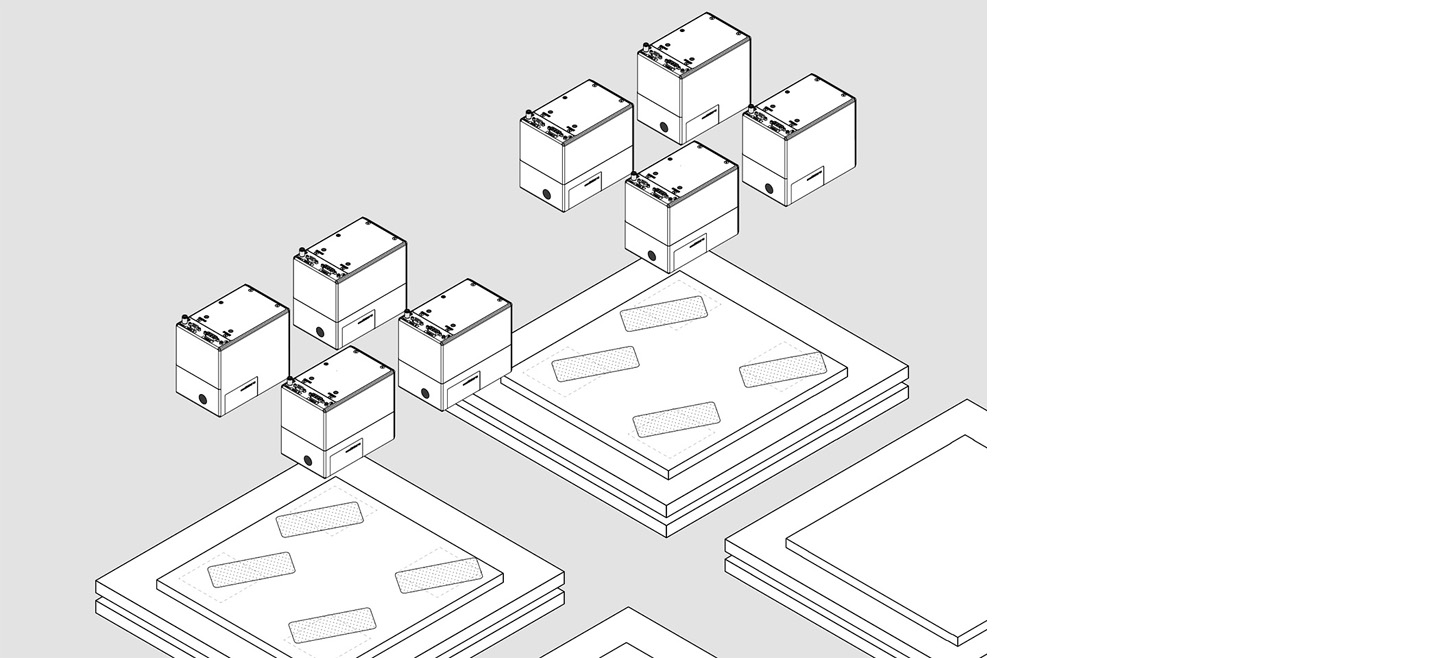
Multi-head and multi-stage scalability
XL SCAN is designed for industrial scale-up. The architecture supports multiple SCANmotionControl instances, multiple stages, and multiple scan heads above the same stage.
That opens paths to:
- parallel drilling lanes on huge panels,
- “strip-processing” of web materials,
- higher yield by distributing thermal load among heads,
- line-balanced production cells without redesigning the control logic.
Option with Physik Instrumente (PI) stages
A key integration route for XL SCAN is using precision stages from SCANLAB partner Physik Instrumente (PI). PI is highlighted as an XL SCAN partner providing precision motion stages and ACS-based EtherCAT motion controllers for high-accuracy laser systems.
Why PI stages matter in XL SCAN
Stage performance directly shapes XL SCAN’s combined accuracy and throughput. PI stages provide:
- high stiffness for dynamic motion,
- servo performance and error mapping for ultra-flat positioning,
- options including precision linear stages, air-bearing stages, and gantry configurations.
In practice, pairing an excelliSCAN head with a PI air-bearing or high-precision linear stage produces a system that can:
- traverse large substrates smoothly at constant velocity,
- maintain sub-micron positioning repeatability over long strokes,
- minimize vibration injection into the scan head optical path.
Example configurations
- Sheet-fed micromachining: PI XY linear servo stage sized to the substrate, with XL SCAN splitting the job between stage translation and galvo local motion.
- Web processing: PI gantry stage for long travel in machine direction, with a cross-axis for width; XL SCAN keeps the laser path continuous along the web.
- 3D-XL SCAN option: Add a PI Z axis or SCANLAB excelliSHIFT for height control over non-flat parts, enabling focus-tracked drilling or cutting.
Practical selection guidelines
When evaluating XL SCAN for a project, consider these engineering levers:
- Feature size vs. area
Microvias, micro-perforations, or textures across > 300 mm fields are prime XL SCAN targets. - Process sensitivity to seams
If seams or overlaps are visible or affect function (display apertures, optical films), XL SCAN’s seam-free trajectories are a large quality win. - Dynamic pattern density
Highly segmented paths (dense drilling, hatch fills) benefit most from motion split optimization and SDC. - Stage choice
For best results, use a stage tuned for high accelerations and smooth velocity control; PI stages are a strong, validated option in the XL SCAN ecosystem. - Scalability roadmap
If you expect to add scan heads later, choose an XL SCAN layout that reserves space and control channels for multi-head expansion.
Conclusion and outlook
XL SCAN with SCANmotionControl represents a shift from “scanner-plus-stage” as two separate tools to a single synchronized motion platform. By planning trajectories holistically and supporting automatic laser control, it delivers large-field laser processing without the traditional penalties of stitching, stage-limited speed, or vibration-induced defects.
In UV laser drilling, XL SCAN enables faster, seam-free microvia and substrate hole processing. In display film and functional foil cutting, it supports continuous, high-speed contouring with uniform edge quality. And its capability set extends naturally to texturing, scribing, marking, and any large-field micromachining task that demands both precision and throughput.
With partner options like Physik Instrumente stages and the scalability to multi-head, multi-stage systems, XL SCAN gives OEMs a future-proof architecture for the next generation of large-format, high-precision laser manufacturing.
Authors
Business Development Team, SCANLAB